Round One Feedback: Studio Conversations
Who I connected with
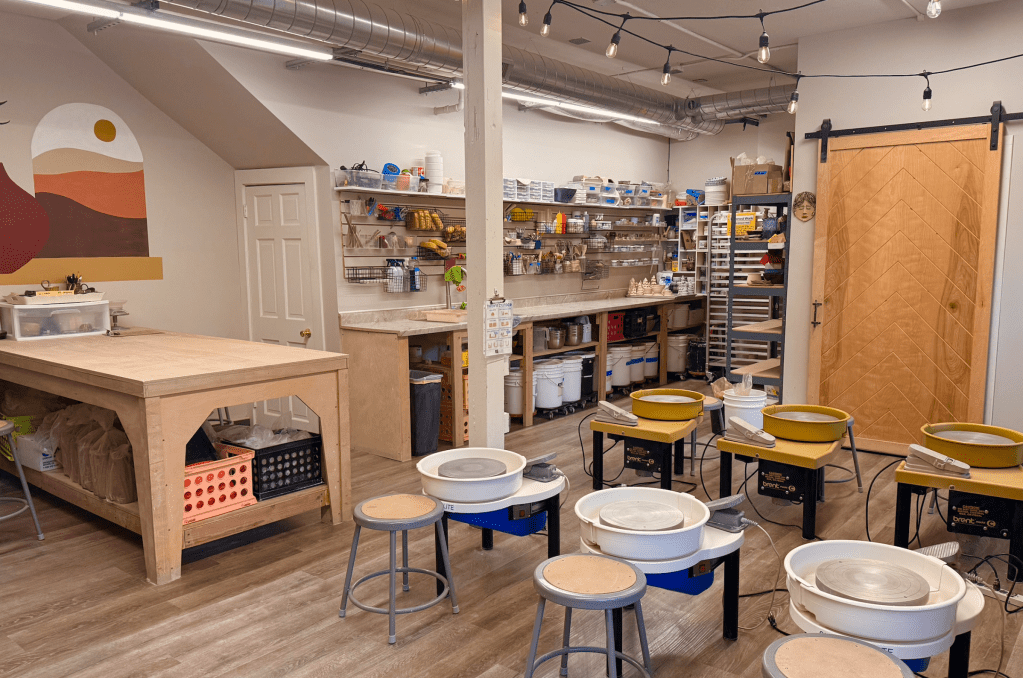
I gathered feedback from three people at the studio where I teach: Babett (owner), Brian (instructor), and Lexie (studio member). All three represent different angles of my target audience. Babett as a studio owner who’d think about admin and member facing tools, Brian as an instructor who’d use it teaching, and Lexie as a working studio member who’d use it day to day. Between the three of them, they cover most of the different user types Tiles is designed for.
How I connected
All three conversations happened face to face at the studio, informal and in context rather than scheduled interviews. Babett did hands on testing directly in the prototype. My conversations with Brian and Lexie were more discussion based, walking through the app and talking through their reactions rather than having them navigate it themselves.
What I shared and what I asked
I showed an early build of the prototype, before glaze photos or the community board existed, so the focus was the test tile archive and piece tracker. I walked through how the archive stores and organizes glaze combinations and how the piece tracker logs a piece through its stages, then asked open questions: does this reflect how you already track this information, what feels missing, and would you actually reach for this in a real studio session.
What feedback they provided
The clearest takeaway was that something felt missing without a shared, social layer, seeing what other members were making and how they were combining glazes. That single piece of feedback became the direct reason I built the community board. Two other ideas came up unprompted, outside the immediate scope. An educational section students could use independently of an instructor, and a way to track studio materials and costs on the admin side.
What I plan to do
The community board is already built and in the prototype as a direct response to this round. The education section and materials/cost tracking are noted as future scope, good directions beyond what I can build in the current timeline, but worth flagging as places the app could grow.
Round One Feedback: Classroom Observations
Who I observed
I observed four beginner level classes at the studio I work for, five to six students each, during their final glazing session (one 2-hour class out of a six-class series). These students represent a core part of Tiles’ target audience, new or developing potters encountering the glazing process for the first time, with very little time to absorb technique, studio setup, and tool use all at once.
How I observed
This was a purely passive observation. I didn’t intervene or guide the outcome. I let students work through the glazing session on their own and paid attention to where they hit friction.
What I was looking for
I focused on pain points, speed bumps, and general friction during the glazing process, specifically where students got stuck, confused, or slowed down without instructor intervention.
What I observed
Two consistent friction points stood out. First, students repeatedly had questions about the studio’s glaze test tiles, some unmarked entirely, others using shorthand notation like “W/B” (White over Blue) that meant nothing to someone encountering it for the first time. Second, there’s no official system for tracking which glazes are applied to which pieces. Students are handed paper to jot this down themselves, or occasionally use a notes app, but nothing is built into the studio experience. Both issues are compounded by how little time students get. One class to learn glazing technique, tool use, and studio setup all at once, with no room to also puzzle over unclear notation or invent their own tracking system on the fly.
What I plan to do
This directly reinforces two existing pieces of Tiles. The test tile archive (which solves the unmarked/unclear notation problem by making combinations searchable and legible) and the piece tracker (which replaces the ad hoc paper/notes-app tracking with something built for the studio). This observation strengthens the case for both features as core to the app rather than optional additions, and suggests an on boarding or first-time-use flow could help address the time-crunch problem directly.
 The entire studio in your pocket.
Leave a comment